

Blog
Supporting Seniors with Visual or Hearing Impairments at Home
When perceptual abilities diminish with age, everyday activities become challenging.At Good Hands Home Health Care, we provide in-home care for sensory impairments that helps individuals maintain their independence. Our staff understands the unique challenges these conditions create and helps build secure, navigable home environments. Whether your loved one faces macular degeneration, presbycusis, or dual sensory impairment, we address both practical needs and emotional wellbeing. Through adaptive techniques seniors can use and supportive technologies, we help those with vision loss and age-related hearing loss continue living confidently at home.
Understanding Age-Related Sensory Changes
Common Vision Problems in Seniors
Elderly individuals frequently develop cataracts, macular degeneration, glaucoma, and diabetic retinopathy as time progresses. While certain conditions advance gradually, others necessitate prompt medical intervention. These limitations significantly impact daily living vision loss management, affecting crucial activities such as reading materials, preparing meals, and handling medications, frequently triggering frustration, anxiety, and withdrawal from social interactions among those experiencing visual restrictions.
Age-Related Hearing Loss
Presbycusis, the progressive hearing loss associated with aging, impacts communication and quality of life for many older adults. This condition typically manifests initially as difficulty distinguishing speech amid background sounds, particularly in crowded environments. Without proper support, hearing impairment can lead to social disconnection, communication barriers, and isolation.
Key Challenges for People with Hearing Loss:
- Struggling to follow conversational exchanges, especially in noisy settings.
- Misinterpreting critical information, including healthcare instructions.
- Diminished awareness of environmental cues and safety signals.
- Progressive withdrawal from community activities and family interactions.
Research increasingly demonstrates connections between untreated age-related hearing loss and cognitive deterioration, making early intervention crucial. Our staff is trained to identify signs of hearing challenges and implement effective communication strategies that maintain connections and cognitive engagement.
Dual Sensory Impairment
When both vision and hearing deteriorate, individuals face unique obstacles that require specialized assistance. This condition substantially increases the risk of falls, depression, and isolation. Good Hands Home Health Care performs thorough evaluations for clients experiencing dual sensory impairment, crafting integrated approaches that optimize remaining capabilities while implementing techniques for daily living vision loss and maintaining independence.
Creating a Safe and Accessible Home Environment
Home Modifications for Visual Impairments
Appropriate illumination constitutes the cornerstone of accessible environments for individuals with visual limitations. Strategic positioning of task lighting in functional zones dramatically enhances visibility, while motion-activated illumination eliminates the need to locate switches in darkened areas. Our caregivers implement glare reduction strategies that minimize discomfort and improve clarity for those with macular degeneration care requirements.
Essential Home Modifications for Visual Safety:
| Area | Modifications | Benefits |
|---|---|---|
| Lighting | Task lighting, motion sensors, automatic night lights | Reduces falls, improves function, increases independence |
| Color/Contrast | Contrasting switch plates, colored tape on edges, high-contrast dishware | Enhances visual cues, improves safety, supports daily activities |
| Organization | Tactile markers, consistent placement, simplified spaces | Reduces frustration, supports memory, maintains independence |
| Pathways | Secured rugs, removed obstacles, guide rails | Prevents falls, improves mobility, increases confidence |
Our professionals work collaboratively with occupational therapists to identify and implement the most effective modifications for each client’s specific condition and home configuration. These environmental adaptations significantly minimize fall risk while supporting continued autonomy in daily activities for people with vision loss home care requirements.
Assistive Technology for Vision Loss
Modern technology offers incredible support for individuals with visual challenges. From basic magnification tools to sophisticated smart home systems, these innovations enhance independence and safety. We help clients select and use appropriate technologies, including electronic magnifiers, voice-activated assistants, high-contrast displays, and specialized mobility aids customized to their preferences and needs.
Hearing Support Modifications
Establishing hearing-friendly environments involves multiple strategies including amplification devices, visual alert systems for doorbells and smoke detectors, and acoustic improvements that minimize background noise. Good Hands Home Health Care implements these modifications alongside communication enhancement tools, ensuring individuals with auditory impairment remain connected, informed, and protected within their residences while preserving their autonomy.
Kitchen and Bathroom Safety Adaptations
For individuals with perceptual limitations, kitchens and bathrooms present distinctive challenges requiring specialized modifications. Our caregivers implement tactile indicators on appliances, elevated bathroom fixtures, color-contrasted surfaces, and specialized alert systems that accommodate both visual and auditory limitations while maximizing independence and safety during essential daily routines.
Communication Strategies and Support
Effective Communication with Vision Loss
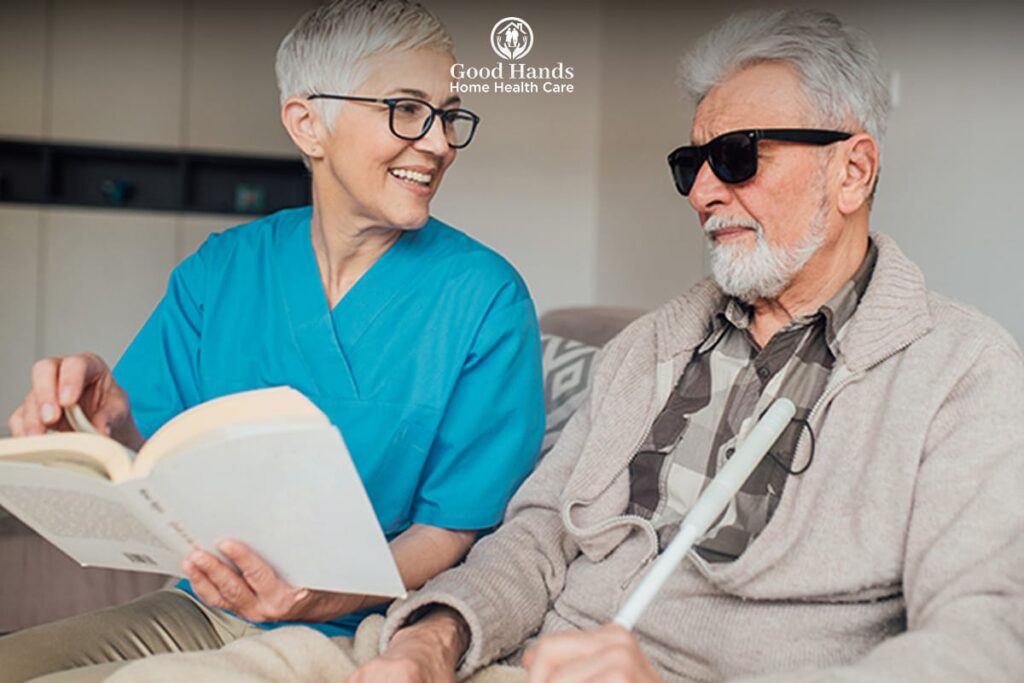
Caregivers supporting independent living blind seniors provide clear verbal descriptions of surroundings without overwhelming details. They announce their presence when entering spaces and departure when leaving to prevent startling. Our approach offers assistance respectfully, using specific directional language like ‘on your left’ instead of ambiguous terms like ‘over there’ to support spatial orientation.
Supporting Those with Hearing Impairments
Effective communication with people experiencing hearing loss elderly care demands patience and specific techniques. Our caregivers position themselves directly before clients, ensuring adequate lighting on their faces to facilitate lip-reading and visual cues. They speak distinctly at a moderate tempo without raising their voice, which can actually distort sound and cause discomfort with hearing aids.
Essential Communication Techniques:
- Eliminating ambient noise before important discussions.
- Utilizing simple writing, visual aids, or tablet devices when necessary.
- Verifying comprehension through gentle questioning.
- Maintaining natural vocal tone and facial expressions.
We recognize that communication barriers can significantly impact emotional wellbeing. Our caregivers establish communication-friendly environments where individuals with auditory limitations feel valued and included rather than isolated or overlooked during interactions and activities.
Technology Solutions for Communication
Modern innovation offers remarkable communication support for people with perceptual limitations. Good Hands Home Health Care assists clients in leveraging video calling with large displays for maintaining family connections, text-to-speech applications for accessing printed materials, specialized amplified phones with visual alerts, and integrated smart home systems that respond to voice commands or visual signals according to individual requirements.
Building Confidence and Independence
Adapting to perceptual changes requires time and support. Our caregivers foster confidence through incremental skill development, acknowledging small achievements while encouraging continued social participation. We connect clients with peer support networks and community resources while providing assistance that honors dignity and autonomy, balancing safety considerations with the importance of continued independence.
Daily Living Support and Adaptive Techniques
Personal Care and Grooming
Our caregivers establish organizational systems for personal care items using texture-based arrangements, consistent placement, and color-coding for those with partial vision. We teach adaptive techniques seniors can master for grooming tasks while incorporating safety measures like non-slip mats and grab bars, helping older adults maintain personal appearance and self-assurance despite visual or auditory limitations.
Meal Preparation and Nutrition
For individuals with perceptual challenges, meal preparation involves specialized organizational systems and safety techniques. Our experienced caregivers implement tactile labeling for pantry items, adaptive cutting techniques, pre-measured ingredient systems, and appliance modifications. We also provide shopping assistance and nutritional monitoring while supporting independent eating through adaptive dishware and dining techniques.
Medication Management
Managing medications safely presents significant challenges for individuals with perceptual limitations. Our caregivers implement comprehensive systems including talking prescription bottles, tactile identification methods, and automated dispensers with alarms. These specialized approaches ensure accurate medication administration while supporting independence.
Medication Safety Strategies:
- Regular medication reviews with healthcare providers.
- Consistent storage locations with sensory markers.
- Emergency medication information in accessible formats.
- Clear protocols for medication side effect monitoring.
Good Hands Home Health Care acknowledges that medication errors can have serious consequences. Our systematic approach incorporates multiple safety checks while respecting each client’s desire to maintain appropriate autonomy in health management.
Mobility and Transportation
Maintaining mobility is essential for people with sight limitations. Our team provides orientation training within familiar environments, introducing adaptive techniques like trailing walls and identifying landmarks. Our caregivers support safe navigation using appropriate mobility aids while arranging transportation options and accompaniment services that help independent living blind seniors maintain community connections despite visual impairment.
Social Engagement and Activities
Perceptual impairments shouldn’t result in isolation. Our specialized caregivers help older adults adapt favorite pastimes using large-print materials, tactile crafts, and amplified audio options. We introduce appropriate technology for entertainment and social connection while identifying community resources with accessibility features. Our team actively prevents isolation by maintaining meaningful activities and relationships despite visual or auditory limitations.
Our Specialized Sensory Support Services
We offer comprehensive support for individuals experiencing visual impairment, hearing loss, or dual challenges. Our specialized sensory impairment home care services include:
- Customized perceptual assessments conducted in clients’ residences.
- Implementation of environmental modifications and assistive technologies.
- Specialized training for family caregivers in support techniques.
- Accompaniment to medical appointments with communication assistance.
- Adaptive strategies for maintaining cherished activities and connections.
- Regular evaluation and adjustment as needs evolve.
Our caregivers receive specialized training in support techniques and remain current with emerging technologies and approaches. We coordinate with vision and hearing specialists, occupational therapists, and other healthcare providers to ensure comprehensive care that addresses both functional needs and quality of life.
Good Hands Home Health Care understands that each client’s experience is unique. We customize our vision loss home care approach to individual preferences, cultural values, and specific conditions rather than applying standardized solutions.
Good Hands Home Health Care: Your Partner in Care
Living with perceptual challenges requires support for older adults to maintain independence. Good Hands Home Health Care provides hearing loss elderly care and macular degeneration care that preserves dignity. Our sensory impairment home care helps manage daily living vision loss through adaptive techniques seniors can master. In-home vision loss care shouldn’t restrict life engagement—that’s why we help those with visual impairment, presbycusis, or dual sensory impairment thrive while supporting independent living for seniors with vision loss. Contact us today to learn how we can help your loved one navigate these changes.